
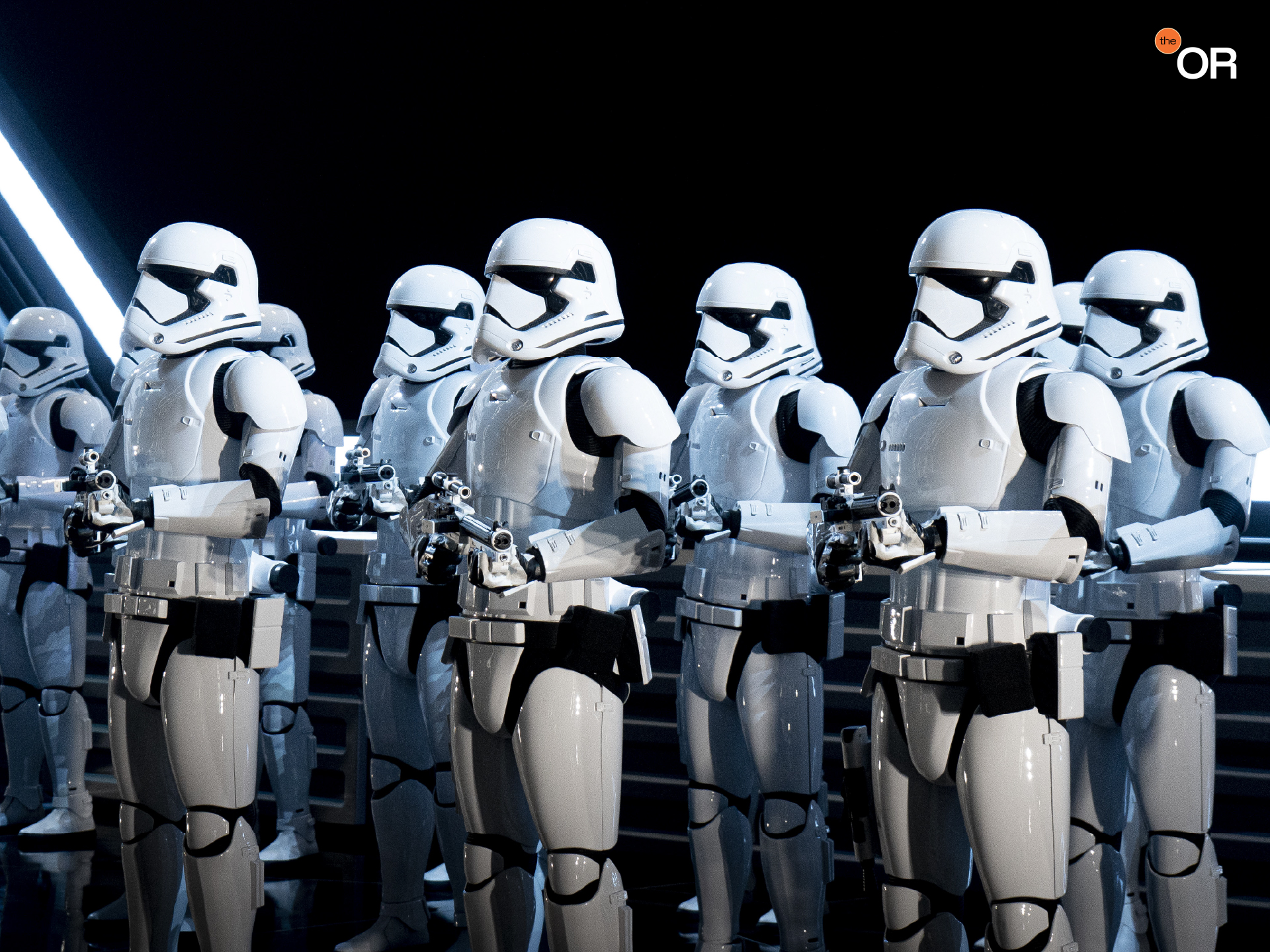
Across its nearly 50 years history, there have been no shortage of wild ideas pitched, rejected, greenlit or passed up on in the Star Wars universe.
Take Star Wars: Underworld, George Lucas’ audacious undertaking to chart the period between Episodes III and IV. Or Josh Trank’s shortlived Boba Fett spinoff movie. Or, most recently, the Acolyte seeing a bitter end after just its first season.
It’s never really too surprising when an article about some rockiness in the galaxy far, far away comes to light. But hearing about The Hunt for Ben Solo is about as stunning as it gets.
A couple of weeks ago, Adam Driver dropped the bombshell to the Associated Press that he had a desire to continue Ben Solo’s story, and moreover, that he contacted Steven Soderbergh to develop his idea. That concept became a fully realized script that Lucasfilm loved — only until Disney, specifically Bob Iger and Alan Bergman, did not.
According to Soderbergh, it was the first Lucasfilm-approved script that Disney ever rejected.
There is a lot to unpack in that.
It’s an unexpected surprise that, of all people, Driver expressed an interest in returning to Star Wars. So much so that he presented a fully finished script to make it happen. Since the sequel trilogy’s conclusion, there’s been no shortage of disdain from the actors most involved in the films. John Boyega has targeted numerous topics, from the toxicity of the fanbase to how legacy characters fit into the sequel picture. Oscar Isaac, more jokingly than anything, said he would only return to Star Wars if he needed another house. Even Mark Hamill publicly critiqued Rian Johnson’s choices regarding Luke Skywalker, criticisms that have since been walked back.
One of the few people openly having a desire to continue their story is Daisy Ridley. But that film project seems to be getting cloudier by the day.
All of that in mind, the mere existence of a concept like The Hunt for Ben Solo comes as a surprise. Steven Soderbergh’s involvement makes it doubly so.
My familiarity with Soderbergh’s work is disappointingly weak, yet the recent Black Bag is one of the more sophisticated widespread theatrical releases in some time. His pedigree of genre-spanning independent cinema is insurmountable. Hence, the prospect of having his work in the Star Wars galaxy sounds like a no-brainer.
Yet, to Disney, it was not. As Driver stated, “They didn’t see how Ben Solo was alive. And that was that.” This verdict coming from the studio that proclaimed, somehow, Emperor Palpatine as alive in The Rise of Skywalker, and a franchise that, from Ahsoka Tano to Darth Maul, has resurrected more characters from the dead than a gravedigger.
Clearly, there’s something more going on here.
That “something” boils down to this: Disney has some disdain for the very trilogy they created.
I used to believe this idea lived only in my head canon. But, look at the shelves at Target or the costumes at Spirit Halloween, and it becomes especially apparent. This story, the denial of The Hunt for Ben Solo, makes it even more so.
For me, the timing of all this has been incredibly auspicious. Just as this story came to light, I had been deep into writing for The Outer Rim. This blog’s existence came about because of a single idea: that the perception of the sequel trilogy both needs to and is bound to change.
Now, I believe this more than ever before. Luckily, there’s a proven roadmap to do it.
It begins with a trip back to 2005 and the prequel trilogy, specifically, Revenge of the Sith.
–
Somewhat controversially, Revenge of the Sith has long been my favorite Star Wars film.
I’ll be the first to admit the film has flaws, glaringly so as I watched it in theaters earlier this year to commemorate its 20th anniversary. But what became more evident on that rewatch was how audacious the movie is. Few films in this genre are quite as melodramatic, action-packed and downright cinematic as Revenge of the Sith.
It’s partially why the film did so well at the box office upon its re-release, earning $55 million across a single week, and why it has continued to be reappraised in the years since its release.
I have to ask myself, though, had I saw the film at an AMC in 2005, would I feel the same way? Probably not. It’s a bit of an impossible question to ask my four-year-old self, though. Because that kid didn’t have a show called Star Wars: The Clone Wars.
Plunging into Star Wars in the 2010s, The Clone Wars dominated my childhood. I distinctly remember playing Lego Star Wars III on the Xbox 360 as I churned through the pages of character encyclopedias. In a time devoid of movies, the show was my Star Wars.
Having said that, The Clone Wars of today is very different than it was a decade ago. No longer is it that distant pocket of spin-off stories set in another universe few seemed to care about. Instead, it’s the connective tissue that binds together modern Star Wars storytelling.
That reputation, which reached its peak with 2020’s seventh and final season, is why I so desperately wanted to give this show a proper rewatch.
Having finally done that — all seven seasons, 133 episodes and 56 hours of runtime — it’s easy to see what makes The Clone Wars an essential piece of Star Wars canon, how it singlehandedly boosted the prospects of the prequel trilogy, and more importantly, why today’s Star Wars — specifically, the sequel trilogy — demands the same treatment itself.
–
I’m not going to waste much time here summarizing The Clone Wars. Most fans know it better than me. But, simply put, The Clone Wars is a microscopic look inside the prequel era. It transports the audience to nearly every corner of the galaxy, embroiling us in massive battles, Jedi missions and complex political conflicts, while crafting fan-favorite characters like Ahsoka Tano and Cad Bane and adding new layers to those we had already come to know and love.
The Clone Wars — a microscopic look inside the Jedi knights, planetary battles and personal drama surrounding the titular conflict — emerged out of George Lucas’ desire to explore the prequels to a deeper degree. That is, in large part, because three movies could only tell so much of the story.
Movies must often fit within certain parameters. There is a limit to budget, visual effects, and, most pressingly, time. Time to make a project and the runtime into which it needs to be compressed.
The original Star Wars trilogy walked this line extremely well. It was remarkably innovative given its budget, tightly focused on a trio of characters battling a single adversary, and ultimately, a simple story of good prevailing over evil.
That, by design, is not the prequel trilogy. The number of planets, characters, clone legions and storylines far outweighs those of the originals. It’s both what I love so deeply about the era — the scope, scale and depth of it — and part of what initially made the movies flounder.
Despite the tremendous commercial success, nearly two billion dollars adjusted for inflation, much of the reception to the prequel trilogy was fairly muddled. That reputation continued to plague the films for years to follow.
Then, two things happened.
First, the younger audience that grew up with the prequel trilogy — the folks for whom the movies were ultimately made in the first place — came of age and started to share their opinions with the world. They were decidedly different than what had been said before.
Secondly, in 2008, came The Clone Wars. It seemed like a risky idea. Too expensive, designed just for kids. Did fans want a project like this, or even, more Star Wars at all? Similar questions are often wagered about the saga today.
In time — and it did take some time — audiences came to find that George Lucas, like always, was ahead of the curve. He saw the depthless storytelling that lay within the complex world of the Clone Wars. In giving this era the space and attention it deserved, he pioneered one of the greatest animated television series of all time.
–
Which brings me to today, and to the sequel trilogy. A quick recap:
Following Disney’s acquisition of Lucasfilm in 2012, The Force Awakens burst onto the scene, which, despite its familiarity, ushered in a promising new era of Star Wars.
Then came The Last Jedi, where things got weird. As to be expected, some of the audience, quite a vocal few, were not fans.
2019’s The Rise of Skywalker came as an answer to those problems, a peace treaty meant to recapture those who saw The Last Jedi as sacreligious, and provide necessary closure to the ideas J.J. Abrams introduced himself at the trilogy’s onset. In trying to be both those things, the movie failed, leaving Star Wars with a sour taste instead of a triumphant victory lap.
The years since can be seen as a form of damage control. Comics, books and games have filled in the gaping holes left by the sequel trilogy. In live action, too, many of Disney’s streaming projects, such as The Mandalorian, have planted the seeds for what unfolded in the sequels. To those who have followed along, it all starts to make a little more sense.
But a large portion of the audience has ignored those books, ignored everything Disney has produced since the sequel trilogy. That includes the Emmy award-winning Andor, anime-driven Visions, and another film I’ll fight in defense of, Solo.
In essence, the sequel trilogy unintentionally alienated a section of fans just as the prequels did over twenty years ago. It took a lot of time, memes and television to win that portion of the fanbase back. Now, a sequel era animated series could do the same.
–
It’d be unfair to ignore the fact that Lucasfilm already attempted this with Star Wars Resistance.
That show, encompassing forty episodes across two seasons, served as a sort of companion piece to the sequel trilogy. It kicks into gear six months before the events of The Force Awakens, crosses paths with The Last Jedi and leads directly into The Rise of Skywalker.
Therein lies the problem. Resistance premiered in October 2018, when the Star Wars distaste had never been stronger. A number of fans had already checked out of the sequel trilogy. An anime-style show hyper-focused on a younger audience had little chance to win them back.
That’s a shame, because ask those who saw it, and Resistance is well worth the time. It introduced a brazen group of Rebels — something Lucasfilm has proven a knack for — dropped in a few familiar faces and proved just how intriguing the sequel era can be.
But with only two seasons, it could only begin to address some of the sequel trilogy’s most interesting moments — from the Resistance’s origins as the First Order lurked in the Unknown Regions to the construction of Starkiller Base and Hosnian Prime’s destruction at its hands. The sequel trilogy is full of fascinating arcs like these yet to receive significant attention.
Resistance was also a victim of Lucasfilm Animation’s own success. These dense, world-building conflicts are the ones they’ve had so much success expanding on before.
The Clone Wars isn’t the only example of this. Star Wars: Rebels is an incredible portrayal of the complex relationship between master and apprentice, while The Bad Batch masterfully displayed the tension in the galaxy as the Empire’s reign took hold.
As a general concept, even beyond animation, the idea of going back in time to set up the future is part of the Star Wars DNA. It began with the prequels, and has carried through the present day with Andor. In almost every case, that formula has worked to success.
Yet, there has been an unwillingness to take the leap with a sprawling, animated story for the sequel trilogy. At the mainstream level, specifically in big-budget television and filmmaking, Disney has shown minimal interest in promoting the trilogy.
I attended my first Star Wars Celebration earlier this year in Japan. For all the excitement over the 20th anniversary of Revenge of the Sith, there was little mention of the fact that it had been ten years since The Force Awakens. A conversation was scheduled with Oscar Isaac, but he backed out due to scheduling conflicts. An entire panel celebrated Lucasfilm Animation, and I cannot confidently say that Resistance was mentioned at all.
–
In some ways, that’s understandable considering the backlash to the sequels. But much has changed since then.
Opinions temper over time. My thoughts on The Last Jedi have changed very strongly since first seeing it, and that’s likely true for many others. Audiences have changed as well. The perception of animation, particularly in the Western world, has undergone a dramatic shift.
Streaming has opened an accessible gateway to past stories. Countless people have revisited shows they may have skipped during the Cartoon Network days. The Clone Wars has seen a tremendous resurgence, while Rebels is more relevant than ever, as its characters have made the live-action leap with Ahsoka and the forthcoming The Mandalorian and Grogu.
Which leads to a critical point. Not only do I want to see a sequel animated series on a personal note, it should also be business priority number one for Lucasfilm.
Three years ago, Disney took the Star Wars Celebration stage to announce Daisy Ridley’s return for a new film in the franchise, set following the events of The Rise of Skywalker. Nothing but crickets have followed in the time since.
If Disney wants this film to succeed, it is in their best interest to re-energize fans about the sequel trilogy and potentially win back those who never gave it a chance in the first place. An animated trilogy is a tremendous way to do that. We’ve seen it work with The Clone Wars. We’ve seen the formula replicated to success with Rebels. And, in The Bad Batch, too.
Now, I can confidently say I’m not the only one who wants to feels this way either. The response to The Hunt for Ben Solo, on internet forums and Times Square billboards, has been clear and obvious: fans want to see more stories set in the sequel trilogy.
Animation is the right place to deliver this. Historically, it has reshaped characters, narratives and entire eras. In time, it can do the same for the sequel trilogy.
Take it from the words of Lucasfilm’s Chief Creative Officer, Dave Filoni, the practical heartbeat of Star Wars, at San Diego Comic-Con earlier this year.
“Fans have embraced our work in a way that no one could have predicted – well, maybe one person did. George Lucas always believed in animation and believed in our team. He said, ‘Dare to be great,’ and that’s what we’ve done for the last 20 years. I hope we do it for 20 more.”
There’s surely a place in that future for the sequel trilogy. And when this era’s time in the animation spotlight comes, its fate may well change with it.
Leave a Reply