
Hollywood seemed to love the political action thriller in the 2010s. It wasn’t a new genre, of course, but 2013 alone saw a pair of films imagining a terrorist attack on the White House — White House Down and Olympus Has Fallen. The latter of which became so well-loved that it spawned a pair of sequels.
On a different front, Argo and Bridge of Spies swooned the Academy Awards. And, in the television world, ABC introduced Scandal and Designated Survivor, both of which captured sizable audiences.
There’s a wide range of subgenres represented across those examples — from history to espionage — but Kathryn Bigelow occupies a space all her own. Combining a hyper-focused attention to detail with the heightened drama that only cinema can provide, Bigelow has seemingly perfected the art of the political thriller. She too contributed to the 2010s, with the critically acclaimed Zero Dark Thirty.
So, there was a palpable aura when Bigelow took the stage for a Q&A at New York’s Paris Theater, following an encore screening of her latest film, A House of Dynamite. Sitting comfortably in the realm of the political thriller, Bigelow ups the stakes this time, with a fictional story depicting the United States’ response to an intercontinental missile launched toward Chicago.
Again, though, Bigelow elevates that idea to new heights. In a complete reversal of the typical doomsday scenario, Bigelow crafts a film that poses more questions than answers. It’s an apt fit to the chaotic situation its characters face, yet at the same time, crafted with a sniper’s precision that makes it all too realistic to the world we find ourselves in as well.
A House of Dyamite adopts a triptych structure, depicting the United States’ harried response to a surprise attack from various perspectives, unwinding more of the story with each take. The film wastes little time with filler or exposition, setting the stakes immediately. And, for the next hour and fifty-two minutes, it doesn’t lower them at any time.
It’s a highly effective strategy that, for Bigelow, ultimately comes down to preserving tension. A nuclear attack, or any threat for that matter, can emerge in an instant. In the film, that instant means a mere eighteen minutes to catastrophic impact. Drawing this out into a linear, two-hour narrative risks removing the element of immediacy that is so essential to nuclear conflict.
This immediacy reigns over the film’s entirety, from the emotions of the characters — each with their own livelihood at stake — to the “DEFCON” scale ticking down like a time bomb, and the literal bomb making its way to the United States mainland.
Yet, the film’s drama lies predominantly in procedure, making all the set pieces, wardrobes and language that occur across those eighteen minutes all the more critical.
That is where Bigelow, and writer Noah Oppenheim, shine the brightest. A former executive producer and president of NBC News, Oppenheim brings a lived experience to the script that few other screenwriters could. His connections, along with Bigelow’s previous relationship with the armed forces, provided the creative team with unparalleled access to individuals who had faced, or at the very least, trained for a situation as depicted in the film.
Those connections, along with a peek inside the real U.S. Strategic Command — STRATCOM — headquarters, gave the film all it needed to recreate the scenarios that would cascade following a nuclear event. And, in a key detail, the cast acted out these scenarios in real-time over a teleconferencing call rather than a green screen. Again, immediacy is the priority.
Of course, this is a work of fiction. There is the luxury of multiple takes and dramatic fiction, but these efforts for accuracy do not go unnoticed. Collectively, they make the film feel much more like reality than fiction. And, for Bigelow, that is the scary part.
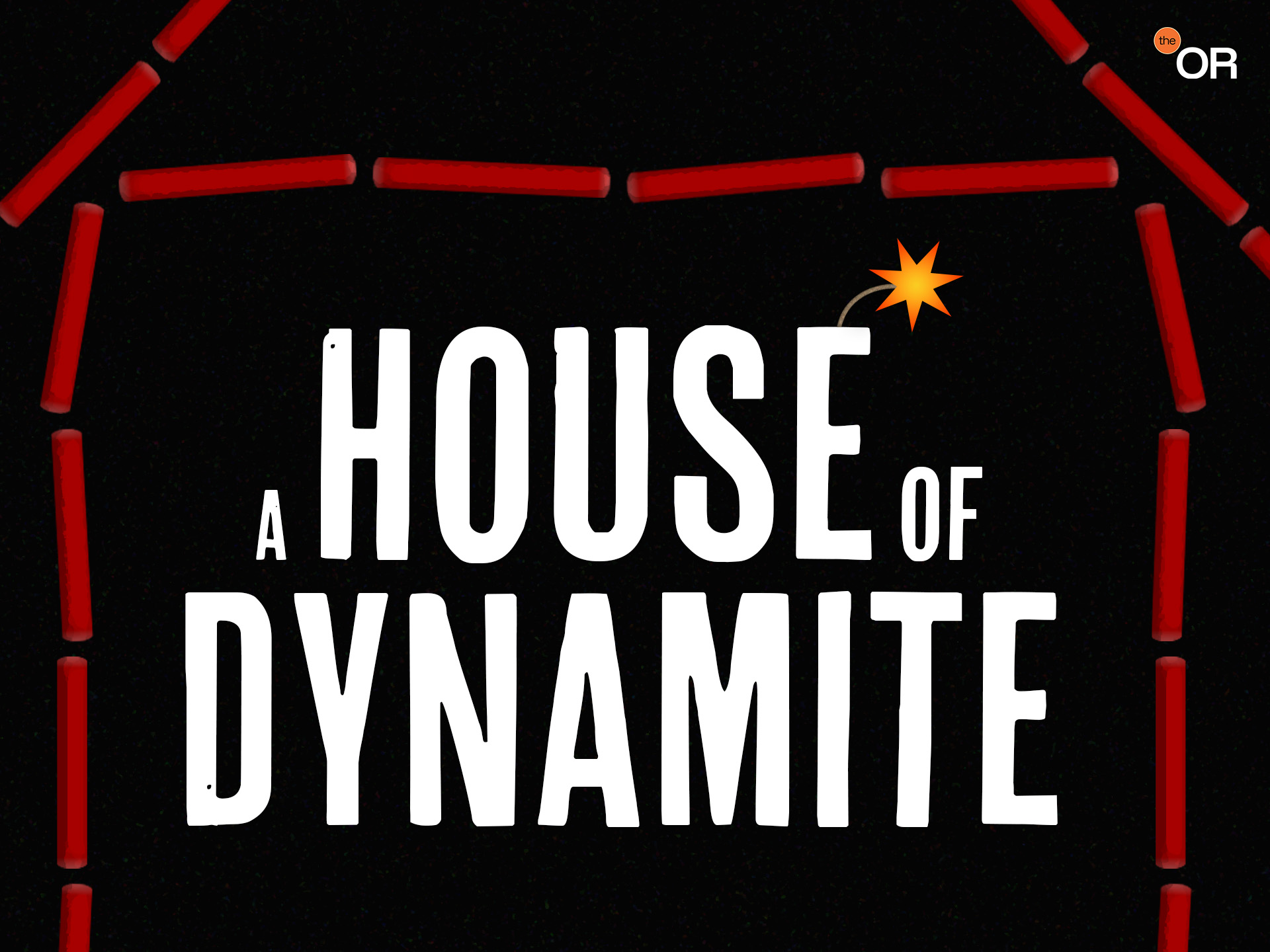
Rooted in her own memory of Cold War-era bomb drills, Bigelow remains mystified by the incredible proliferation of nuclear weapons that has unfolded in the new century, putting us all under the roof of “a house of dynamite.”
In that sense, the film is both a political thriller and a political message, designed to awaken the audience to a realization of the dire situation our world occupies — one where mass tragedy of unfathomable scale can unfold in a few short minutes.
It’s also a world with no winners, and in that sense, Bigelow’s controversial ending is a natural fit. As she described following the film, Bigelow is less interested in providing a satisfying, definitive end to a story than in opening up a broader question.
By presenting an open-ended conclusion, Bigelow asks the audience to place themselves in the shoes of the film’s characters. Only in doing so do the impossible circumstances of nuclear conflict take hold for those who would otherwise never feel the consequences of them. That sense of empathy is the film’s greatest strength, and something only a director like Bigelow can provide.
Many who watch the film on Netflix, where it is now streaming, may have a different impression. The knee-jerk reaction is to be disappointed — I certainly was at first. But, at the very least, it will have audiences talking, and for Bigelow, that conversation is the most meaningful response.
Leave a Reply