
I had not heard of The Testament of Ann Lee until about a month ago. My family and I went to see Rental Family, another Searchlight Pictures release, and the trailer popped up for the first time. Paying half-attention, I did not catch it much, but it caught my brother’s eye. And, when anyone in my household makes any mention of wanting to see a movie, we go.
See, my brothers have a way of taking one film each holiday and running with it. In 2024, it was Nosferatu. Then, it became the “Dream Big” slogan of Marty Supreme. Now, it is The Testament of Ann Lee, with its shaking, quaking and everything in between.
It has been a highly effective way to build our own excitement for new releases. The event only became bigger with a 70mm print and a brief intro from director Mona Fastvold and co-writer Brady Corbet, who together delivered Corbet’s Best Picture winner, The Brutalist.
That all had us fairly excited to see The Testament of Ann Lee on Saturday night. The two and a half hours that followed made for what is easily one of the year’s very best films, and an experience that demands to be seen on the big screen.
—
On paper, The Testament of Ann Lee is an odd undertaking. Ann Lee, founder of the Shakers — an offshoot of the Quaker faith known for their gyrating movements during worship and utopian, celibate ideals — does not come up in history class. The religion, now numbering just three, never really grew into prominence.
Born out of exposure to a traditional Shaker hymn, Fastvold conceived the film as a musical from the onset, a traditionally alienating genre. Especially so here, considering the niche subject matter, and the film’s responsibility to be an accurate period piece at the same time.
Getting the project off the ground, unspririnsgly, started as a struggle. The freedom that follows the success of a film like The Brutalist was yet to come. But, studio support aside, Fastvold and company never wavered on their idea of what they believed the film could be.
With the final product now making a limited theatrical release, it is quite easy to see why.
Being Fastvold’s first attempt at adapting the story of a real-life figure, The Testament of Ann Lee confidently establishes its historical basis. It checks all of the boxes that a biographical picture must, shepherding the audience through each stage of Lee’s life. Fastvold certainly employs some creative liberties, but what is most essential about Lee’s character and the supporting cast around her is here. It is all cloaked in a very compelling recreation of 18th-century Manchester and New England too.
Beyond that, however, everything is beyond ordinary. The Testament of Ann Lee is proudly a musical, and its unapologetic embrace of that identity enables the film to become something much greater than it could ever otherwise be.
That begins with Amanda Seyfried. Seyfried is, of course, no stranger to musical productions. She performed in theater at an early age, before bursting onto the scene with the now-iconic Mean Girls, and then went on to star in projects like Mamma Mia! and Les Misérables.
Even with that background, The Testament of Ann Lee presents a unique challenge. The titular role demands immense strength and physicality counterbalanced by equal parts wisdom and delicacy. Seyfried is more than up to the task with a ferocious performance that commands the screen in each scene. She has a gaze that strikes daggers into the eyes of her followers and an unrestrained freedom of movement, almost appearing possessed at times.
Seyfried thrust herself fully into the role, a quite vulnerable one, delivering a career-best performance as a result. She is simply magnificent.
One of the film’s strongest qualities is the collective buy-in on the part of the cast as a whole. Lewis Pullman is a convincing missionary, spreading the Shakers’ belief to the masses upon their arrival in New York. “John’s Running Song” with David Cale is a standout sidepiece. Nothing, and no one, ever removes the audience from the moment, giving Seyfried every inch to take the stage and shine.
Luckily, she and the cast have some incredible material to play with, too. Daniel Blumberg, who scored Fastvold’s The World to Come, returns to the composer’s seat after winning Best Original Score for The Brutalist. Blumberg ups his efforts this time with a striking combination of traditional Shaker hymns and new songs created specifically for the film.
Blumberg operates with strong respect for the source material. Music here fits very naturally into the story, avoiding sudden bursts into song that can deter people from the genre. He also employs a handful of motifs that grow in intensity as the film progresses. Blumberg, too, wisely uses the freedom to be creative. He employs a range of instrumentation — an electric guitar is one particular highlight — that gives each hymn a subtle cinematic upgrade. The songs are catchy, memorable and bolstered by a chorus of tremendous vocal performances.
Music is the key component to an overall impressive soundscape. Be it a tap of a triangle, an offbeat piano key or cattle on the farm, each scene has something that draws in the ear. The film is a rapturous sonic experience that envelops the theater, creating a scenario where I could not pull my attention away from the screen for a second across its tightly woven 137-minute runtime. It is undeniably oppressive, but that feels like a strong fit for the pulsating energy that fills the Shakers, often overcome by visions of what is to come for their burgeoning faith.
Presentation is the film’s calling card, but Fastvold has assembled an excellent story to pair with it. Some may find it a bit simple — a fairly straightforward biography, told linearly, with a very defined beginning and end. Yet, there is no attempt to over-editorialize, augment the facts or apply judgment to Lee’s character and her decisions.
The film is a respectful portrayal of one of history’s forgotten figures, and of a movement that had a sizeable impact on culture. Ann Lee grew to prominence at a time when few other female religious leaders did. The Shakers are still renowned for their folk art, furniture, meticulous craftsmanship and cultural values.
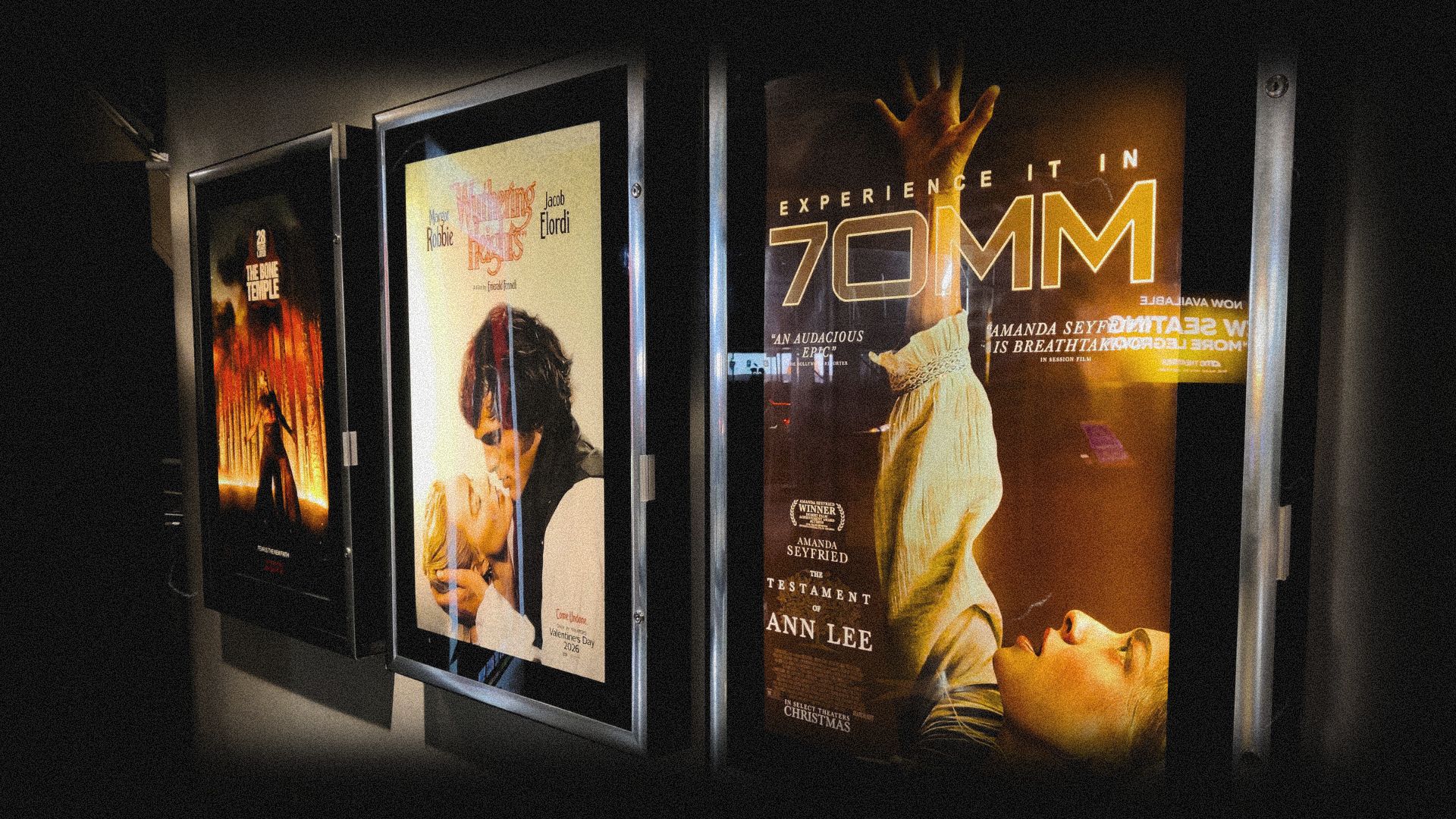
Fastvold directs with this same level of precision herself, crafting a film that demands to be seen on the big screen. Experience, a word used so frequently in marketing for this film, is the best way to describe it. The 70mm print, which of course cannot be seen at home, looked gorgeous. Sound — so essential to any musical, but especially this one — was tuned perfectly to the theater where I saw it.
Yes, much of what The Testament of Ann Lee has to say is already on Wikipedia. But to see her life in the vivid manner in which Fastvold has recreated it is something far different. When seen in the right format, it is one of the most remarkable experiences in a movie theater this year.
Which made me think about how it is simply a shame that more people will not see it in this way.
I mentioned The Brutalist earlier, and it is a comparison impossible to ignore. The filmmaking duo is the same, simply swapping places. The $10 million budgets are nearly identical. The composer is the same, the cast is remarkable. They are two tremendous movies.
The Brutalist, released by A24, became a phenomenon, grossing five times its budget and earning 10 Oscars nominations. Despite being every bit as good, in many ways even better, The Testament of Ann Lee seems unlikely to walk that same path. In fact, there has been little mention of it at all, snubbed on the Oscars shortlist in every category.
It is no criticism of Searchlight, which likely has a strong promotional campaign ready to go leading up to a January 16 wide release, but it is an interesting comparison to make. Especially considering that A24 has its own film on the market right now, Marty Supreme, which, under very different circumstances, is thriving at the box office.
But, that is an unnecessary aside. The Testament of Ann Lee has no equal. It is simply one of the year’s very best films. So, like the Shakers so many centuries ago, to those who have already experienced it, I see it as our duty to spread the word.
Leave a Reply